
Sources: Bob Vila, how to screen in a porch (updated July 6, 2022); permit and owner-builder rules from Florida Statutes s. 489.103 (2026).
Patio screen enclosures DIY projects in Florida come in three sizes, and only the smallest is a true do-it-yourself job. Re-screening torn panels on a sound aluminum frame is a weekend project most handy homeowners can do. Screening in a patio that already sits under your house roof is possible with kits. Building a new freestanding enclosure or pool cage is permitted structural work that has to meet the Florida Building Code's wind-load rules, and Florida law sets strict conditions if you want to pull that permit yourself.
This guide covers each of the three, what Florida's owner-builder rule actually says, what a permit desk will ask you for, and where DIY savings disappear. If you would rather have it built for you, our screen enclosures page explains what we build and replace.
Contents
- Three projects people call "DIY screen enclosure"
- Re-screening panels yourself
- Screening in a patio under an existing roof
- Building a new enclosure: the Florida rules
- What the permit desk asks for
- DIY vs. professional cost
- When to call us
- Patio screen enclosures DIY FAQ
Three projects people call "DIY screen enclosure"
| Project | Realistic as DIY? | Permit? |
|---|---|---|
| Re-screening panels on a sound frame | Yes | Ask your building dept. |
| Screening in a patio under the house roof | Sometimes, with kits | Check first |
| New freestanding enclosure or pool cage | Rarely | Yes, with plans |
The main risk grows with each step: a loose spline or sagging mesh on a re-screen, fastening into stucco and slab (and your HOA rules) on an under-roof patio, and wind loads, anchoring and the tie-in to the house on a new cage. Most of the savings people hope for are on the third project, and that is the one where DIY is hardest to do legally and safely.
Re-screening panels yourself
If the aluminum frame is straight and solid and only the mesh has gone chalky or torn, replacing the screen is a reasonable DIY job. Each panel's screen is held in a channel by a rubber spline. The basic steps:
- Pull out the old spline with a pick or flat screwdriver and remove the old mesh.
- Clean the channel so the new spline seats fully.
- Lay the new mesh over the opening with a few inches of overlap on every side.
- Roll the spline into the channel with a spline roller, starting on one side and working around, keeping the mesh taut but not stretched out of square.
- Trim the excess mesh with a sharp utility knife along the outside of the spline.
Use fresh spline, not the old one: it shrinks and hardens in the sun. Pick the mesh for where you live. Standard 18x14 fiberglass keeps mosquitoes out. Near canals, mangroves and preserves, tighter 20x20 no-see-um mesh is worth it, and pet-grade mesh on the lower panels stands up to dogs.
Two-story panels and roof panels on a pool cage are a different matter. They mean working off tall ladders over a pool deck, and that is the point where most homeowners hand it off. Our lanai rescreening and pool cage rescreening pages cover how we do it.

Screening in a patio under an existing roof
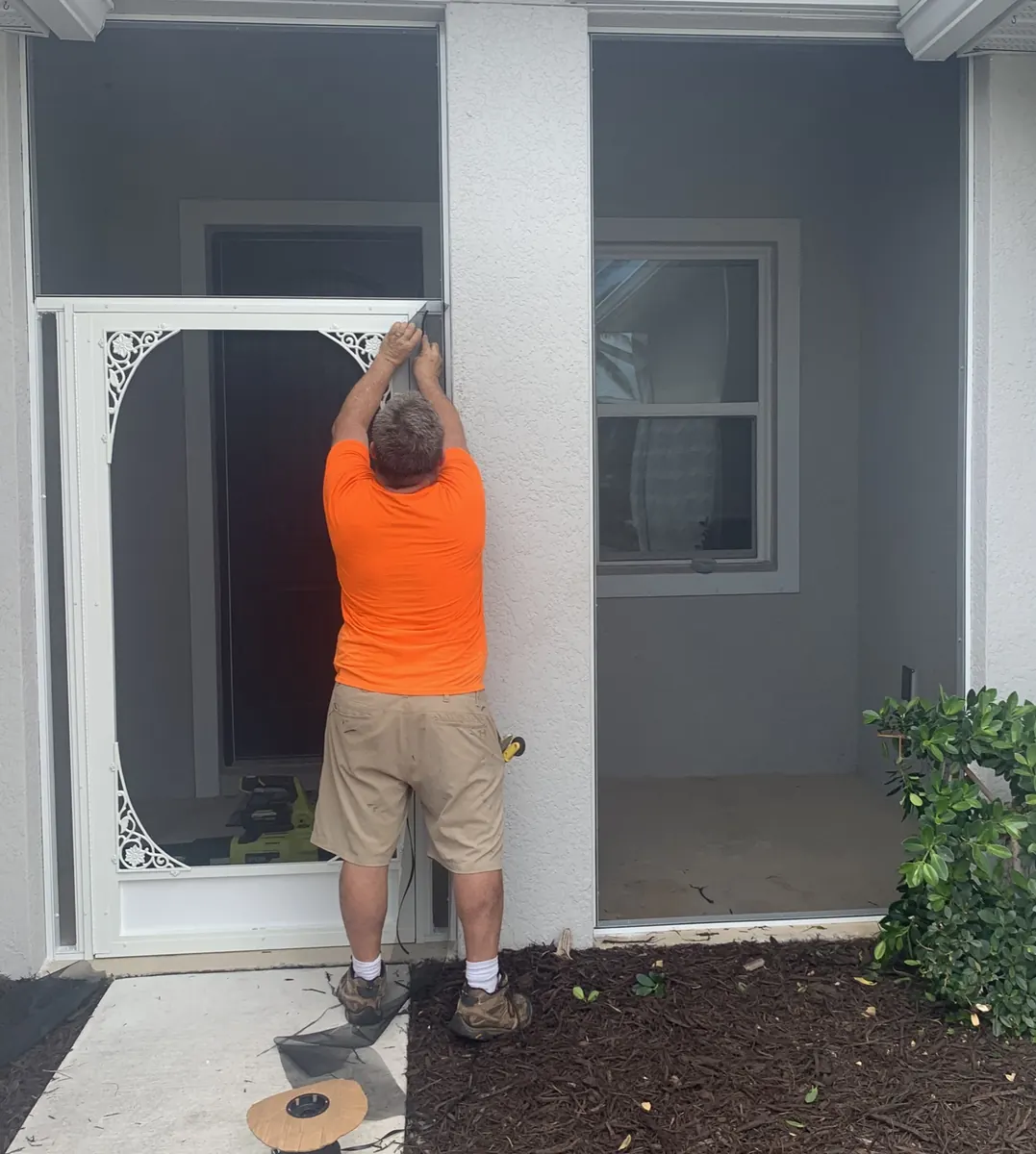
A patio or lanai that already sits under the house roof needs walls only, which is why it is the most common DIY enclosure project. Bob Vila notes that a pre-made kit for an 8 by 8 foot opening sells for about $250 to $300, that kits can be cut down but not enlarged, and that screening in an existing covered porch of about 200 square feet could cost as little as $450 in materials.
Bob Vila also notes a permit may not be needed if you are not changing the structure of the house, but advises calling your local building authority to check. Do that before you buy anything. Here, a few more things to check first:
- Your HOA. In a community with a homeowners association, you usually need its approval before work starts, and many have rules on frame color and screen type.
- What you are fastening into. Many Southwest Florida homes are stucco over concrete block, with a concrete slab. The frame needs anchors rated for masonry, set where they will not crack the slab edge.
- Doors. A self-closing door that latches is what keeps the bugs out. It is also the part that takes the most wear.
Building a new enclosure: the Florida rules
A new or replacement screen enclosure is permitted work in Florida. It has to meet the wind-load requirements of the Florida Building Code, which is why the aluminum sizes, spacing and anchoring come from engineered drawings rather than by eye. Hurricane Ian in 2022 took down or twisted thousands of pool cages across Lee and Charlotte counties. A cage that is not built to the code is the one that ends up in the neighbor's yard.
The owner-builder exemption
Florida does let a homeowner act as their own contractor. Under section 489.103(7) of the Florida Statutes, the exemption covers work on your own one- or two-family home, for your own use, at a cost of up to $75,000. The conditions are strict:
- You must personally appear and sign the permit application.
- You must provide direct, on-site supervision of all work not done by licensed contractors, and you cannot hand that responsibility to anyone else.
- You may not hire an unlicensed person to act as your contractor. Anyone unlicensed working on the job must work under your direct supervision, and you take on the employer's duties, including taxes and workers' compensation.
- Selling or leasing the home within one year creates a presumption that you built it for sale, which the exemption does not cover.
In other words, "my cousin and I will put it up" is allowed only if you are running the job yourself, and "a guy with a trailer will build it cheap" is exactly what the law is written to stop.
What the permit desk asks for
Each county and city runs its own permit desk, so check yours. As one example, Collier County's aluminum structures requirements ask for:
- Construction plans showing the scope of work, signed and sealed where applicable.
- A site plan; when the project adds more than 400 square feet of new impervious area, a certified site plan signed and sealed by a Florida-licensed surveyor, architect or engineer.
- The distance to the septic system, where there is one.
- For owners acting as their own contractor, an owner-builder application signed in person and notarized by county staff.
Engineered plans for a freestanding cage are not something most homeowners can draw, so a DIY build usually means paying for the engineering anyway, then doing the heavy part of the work yourself.
DIY vs. professional cost
| Project | DIY | Hired out |
|---|---|---|
| Screen an existing covered porch, about 200 sq ft | From about $450 in materials | Add about $300–$600 for labor |
| Covered deck or screened porch needing new construction | $5,000 to well over $20,000 | |
| Pool screen enclosure | Engineering and permit still required | About $5,708–$16,608 nationally |
Sources: Bob Vila, how to screen in a porch (updated July 6, 2022) for the first two rows; Bob Vila, pool screen enclosure cost (updated May 31, 2024) for the last. National figures.
For the full price picture on a pool cage, see our guide to pool screen enclosure cost in Southwest Florida.
When to call us
Re-screen a panel or two yourself. Call us when the frame is corroded at the base or bent, when the panels are two stories up or on a cage roof, when a storm has racked the structure out of square, or when you want a new enclosure built to the code. We also check the fascia and gutter the enclosure will hang from, because most enclosures attach at the fascia and carry roof water through a super gutter.
Every screen enclosure we build or replace comes with a free written estimate, no deposit, and a lifetime workmanship guarantee, and if you already have a written quote for the same scope, we will beat it. WWJD Gutters has been family-owned since 2007 and is licensed and insured to $2 million. We build enclosures in Cape Coral, Fort Myers, North Fort Myers, Punta Gorda, Bonita Springs and Naples. To talk through your patio, request a free estimate or call us at (239) 342-5489.
Patio screen enclosures DIY FAQ
Can I build a screen enclosure myself in Florida?
You can re-screen panels on a sound frame yourself. A new enclosure is permitted work that has to meet the Florida Building Code's wind-load rules, and you can pull the permit as an owner-builder only for your own home, for your own use, while personally supervising the work.
Do I need a permit to screen in my patio?
A new or replacement screen enclosure needs a building permit in Lee, Charlotte and Collier counties and the cities within them. For screening in under an existing roof, call your building department before you buy materials.
How much does a DIY screen enclosure cost?
Bob Vila puts screening in an existing 200 sq ft covered porch at as little as $450 in materials, with 8 by 8 foot kits at about $250 to $300. A new enclosure still needs engineered plans and a permit.
Can I rescreen my own lanai?
Yes, if the frame is sound. Pull the old spline and mesh, lay new mesh over each panel and roll in fresh spline. Two-story and cage-roof panels are where most homeowners hand it off.
What screen should I use on a patio enclosure?
Standard 18x14 fiberglass keeps mosquitoes out. Near canals, mangroves and preserves, 20x20 no-see-um mesh is worth it, and pet-grade mesh on the lower panels stands up to dogs.
Do I need HOA approval for a screen enclosure?
If you live in a community with a homeowners association, you will usually need its approval before work starts, on top of the building permit.