(239) 342-5489 info@wwjdguttersofflorida.com
Home  /  Siding

Siding repair and replacement in SW Florida.

Cracked panels, storm damage, trim that has given up. We repair what can be repaired and replace what cannot, on vinyl and aluminum siding.

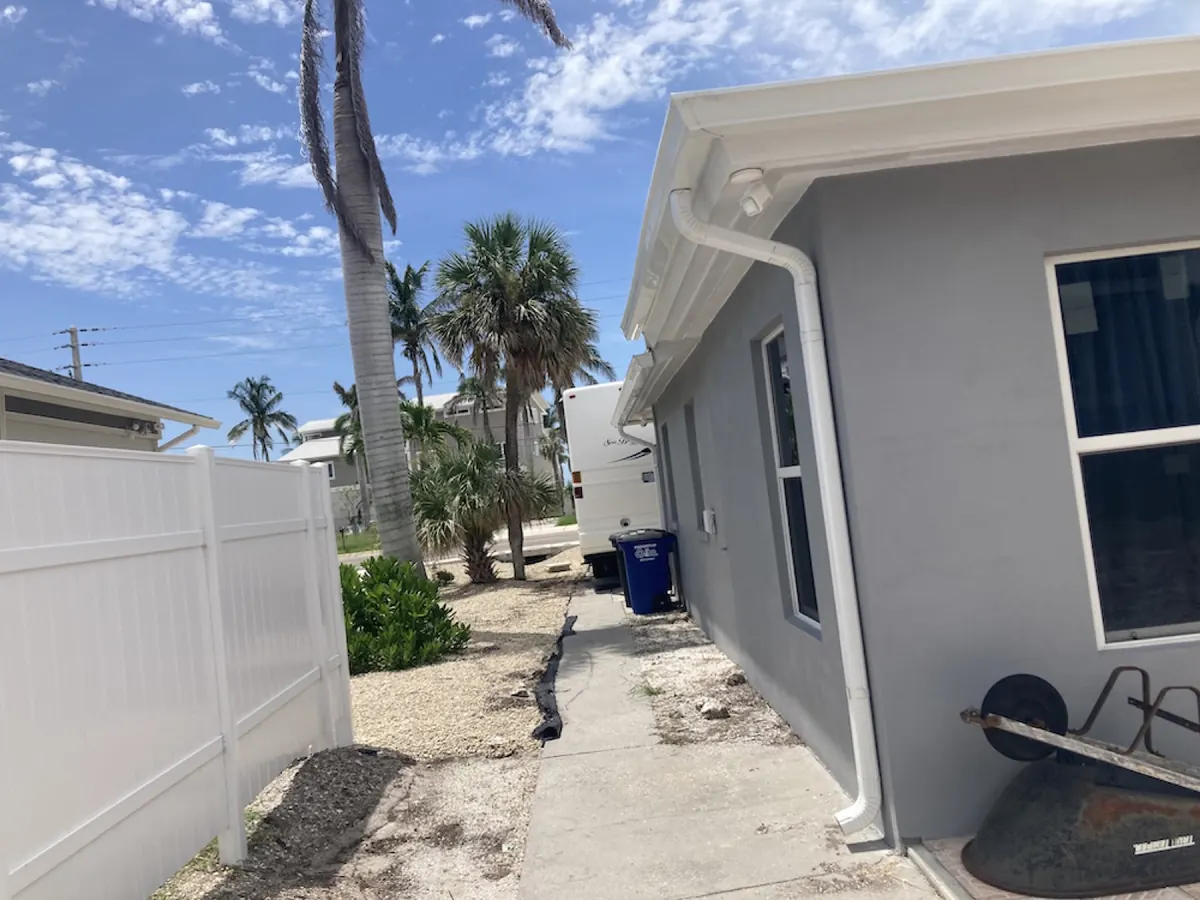
Sun-faded siding on a Southwest Florida home

What Florida does to siding

Two things age siding here faster than almost anywhere: ultraviolet light and heat cycling. Vinyl expands and contracts measurably every single day, and if it was installed nailed too tight, that daily movement has nowhere to go. Panels buckle, seams open, and fastener holes elongate until the run rattles in the wind.

Sun does the rest. Colour fades unevenly depending on exposure, and older vinyl gets brittle enough that a stray branch or a stone from a mower goes straight through it rather than bouncing off.

Aluminum siding does not get brittle, but it dents, chalks as the finish oxidises, and corrodes at cut edges and fasteners in coastal air.

  • Buckling from panels installed too tight to move
  • Brittle vinyl that cracks on impact
  • Uneven fading by exposure
  • Chalking and edge corrosion on aluminum

Wall sheathing exposed behind removed siding

The part behind the panels

Siding is a rain screen, not a seal. It is meant to shed most of the water while the weather barrier behind it handles what gets through, and there should be a path for that water to drain back out. When people close up the bottom of a run or caulk every seam solid, they trap water in the wall instead of keeping it out.

That is why we look behind panels whenever we have a section off. Soft sheathing, staining, or a barrier that has been torn or never lapped correctly are all things you want to know about while the wall is open, not two years later when the damage has reached the framing.

It is also why we are careful about where the water above is going. A gutter overflowing onto a wall or a downspout splashing the bottom course drives far more water at siding than rain ever will.

Siding elevation on a Southwest Florida house

Matching what you already have

The realistic answer on matching is: sometimes closely, rarely perfectly. Profiles get discontinued, and even a correct profile in the correct colour comes out of the box looking newer than panels that have been fading on your wall for twelve years.

There are ways to make that work. Pulling replacement panels from a less visible elevation, such as behind a fence line or on the back of the house, and putting the new stock there instead, is an old trick that puts the mismatch where nobody looks. We will suggest it where it applies.

And when a wall needs so many panels that matching becomes hopeless, we will tell you that replacing the elevation is the better value rather than selling you a patchwork you will resent looking at.

  • Profile and colour matched as closely as stock allows
  • New panels relocated to low-visibility elevations
  • Honest call when patching stops being worth it
  • Trim and corner details finished to match
WWJD crew working along a Southwest Florida roofline
Local crew. Whole exterior covered.
Why homeowners call us

Straight answers, no deposit, guaranteed work.

We beat any written price

Bring us a competitor's written quote and we will beat it, on the same scope of work.

Licensed & insured to $2M

A certified residential contractor serving Lee, Charlotte and Collier counties since 2007.

No deposit, 24-hour response

You pay nothing until the work is finished and you are satisfied with it.

Good to know

Siding questions.

Usually, yes. Vinyl and aluminum siding both lock together course by course, so individual panels can be unlocked with a zip tool and swapped out without disturbing or removing the courses above and below them. The real limiting factor is matching rather than the mechanics of the repair itself — siding profiles get discontinued by manufacturers over time, and existing panels have typically faded in the sun for years, so a close colour and profile match is realistic while a truly perfect, invisible match often is not. We will be straight with you about how close we can get before any work starts, and where the mismatch will be least noticeable, so you can decide what makes sense for that wall.

Almost always because it was nailed too tight when it was originally installed, which is a very common mistake even among installers who do not specialise in siding. Vinyl expands and contracts noticeably every single day as it heats up in the sun and cools at night, and the fastener slots are specifically designed with extra length so the panel has room to slide as it moves. When a panel is nailed too tightly into the centre of that slot instead of left loose, it has nowhere to go as it expands, so it buckles outward and the seams between panels work open over time. When we repair or reinstall siding, we deliberately fasten in the centre of the slot and leave the panel free to move.

We get as close as available stock allows, though an exact match is not always realistic if your existing siding has faded significantly or the specific profile has been discontinued by the manufacturer. One approach that works well and that we use regularly: take panels from a hidden or less-visible elevation, like the back of the house, to patch the section that is actually visible from the street, and put the brand-new, more noticeably different-coloured stock in that hidden spot instead. That way any unavoidable mismatch ends up somewhere nobody is looking rather than on your front elevation. We will walk the property with you and figure out which approach gives the best result.

Whenever a section of siding is off for repair or replacement, yes, every time. Siding itself functions as a rain screen rather than a fully sealed barrier, meaning some water getting behind individual panels during wind-driven rain is normal and expected — what actually protects the wall is the weather barrier and sheathing underneath. That is what we are really checking when a section comes off: whether the barrier is intact and properly lapped, and whether the sheathing behind it has stayed dry and sound. Finding soft sheathing or a torn weather barrier while the wall is already open is dramatically cheaper to deal with than discovering it after new siding has already gone back on.

Yes, both, and they fail in genuinely different ways so they need to be diagnosed differently. Aluminum siding does not get brittle with age the way older vinyl does, so it rarely cracks from a light impact the way a vinyl panel might. Instead it dents when something hits it, the factory finish gradually chalks and dulls as it oxidises in the sun over the years, and it corrodes at cut edges and around fasteners in coastal salt air, which is a real consideration for homes closer to the water. We handle repair and replacement for both materials, and the diagnosis genuinely differs between them, so it is worth telling us which one you have when you call.

Replacement generally makes more sense than continued repair in three situations: when enough individual panels are damaged that finding a reasonably close match becomes impossible, when the material itself has gone brittle across a whole elevation so every repair attempt cracks the panels next to it, or when we find that what is behind the siding needs real attention that patching over the outside will not address. We will give you that assessment straight, based on what we actually find when we look at your wall, rather than defaulting to quoting the bigger, more expensive job by default. Plenty of walls we look at genuinely just need three panels and a corner post.

Related reading

Contact Us

(239) 342-5489

Or, fill out this handy form and we'll get back to you as soon as possible – usually within 24 hours on business days.

Call Now Free Estimate