
Sources: This Old House, best gutter guards (updated October 8, 2026) and DIY gutter guards (updated November 2, 2026).
DIY gutter guards are a realistic weekend job on a single-story house with sound gutters: clean the gutters, buy guards sized to your gutter width, and fasten them along each run. Materials run about $1.50 to $6 per linear foot, against an average of about $40 per linear foot installed by a pro, according to This Old House. The trade-off is that the easiest guards to put in yourself are the ones that cope worst with Southwest Florida's pine needles and summer downpours.
This guide walks through how to put in gutter guards yourself, which types are worth the effort here, the safety and roof-warranty traps, and when it makes more sense to hand the job off. If you decide you would rather not climb, our gutter guards page explains how we install them.
Contents
- Should you install gutter guards yourself?
- Which gutter guards are DIY friendly
- Tools and materials
- How to install gutter guards, step by step
- Shingle, tile and metal roofs
- Ladder safety in the Florida heat
- Common DIY mistakes
- When to call a pro
- Gutter guards DIY FAQ
Should you install gutter guards yourself?
Do it yourself makes sense when all of these are true:
- The house is one story. This Old House advises leaving anything beyond a single-story job to professionals.
- The gutters are sound: no sagging runs, no leaking joints, no soft fascia behind them.
- You are comfortable on an extension ladder, moving it every few feet, for several hours.
- You can work in the cool part of the day and stay off the ladder when a storm builds.
If any of those is a no, a guard you fit yourself is likely to cost more in the end than one fitted right the first time.
Which gutter guards are DIY friendly
This Old House groups guard types by how hard they are to install yourself. Here is that ranking next to how each type holds up in Southwest Florida:
| Type | DIY difficulty | Southwest Florida fit |
|---|---|---|
| Foam insert | Easiest | Poor: stays damp, overflows |
| Brush insert | Easiest | Poor: needles pass through |
| Snap-in screen | Moderate | Fair for leaves; needles get through |
| Screw-on micro-mesh | Harder, precise fit | Best: stops small debris |
| Reverse-curve hood | Not recommended for DIY | Can overshoot a summer downpour |
Sources: This Old House, DIY gutter guards; Florida fit from This Old House's gutter guard testing.
If you are going to do it yourself, a screw-on micro-mesh is the one worth the extra effort here. For a full comparison of every type, see our guide to the best gutter guards for Southwest Florida.
Tools and materials
- Safety: an extension ladder, a ladder stabilizer, gloves and safety glasses. This Old House also recommends a roof harness.
- Cleaning: a gutter scoop, a stiff brush, a bucket or bags, and a hose.
- Installing: a cordless drill, self-tapping screws, tin snips or a fine-tooth hacksaw, and the guards plus 10 percent extra for cuts and mistakes.
How to install gutter guards, step by step
1. Clean the gutters and flush the downspouts
Every guard goes on a clean gutter. Scoop out the debris, rinse the troughs, and run water down each downspout until it flows freely. A clogged downspout under a new guard just moves the overflow somewhere else.
2. Check the gutters while they are clean
Look for the problems a guard would hide: low spots that hold water after you rinse, joints that drip, hangers that have pulled loose, and fascia that feels soft when you press it. Fix these first. A guard on a sagging or leaking gutter covers the problem up.
3. Measure, and match the gutter width
Measure every run and add about 10 percent extra.
Then measure the width of the gutter itself. This Old House notes most homes have 5-inch gutters, but 4-inch and 6-inch gutters exist too. The seamless gutters we install are 6-inch, so do not assume. A guard sized for the wrong width will not seat on the lip.
4. Fit the guards
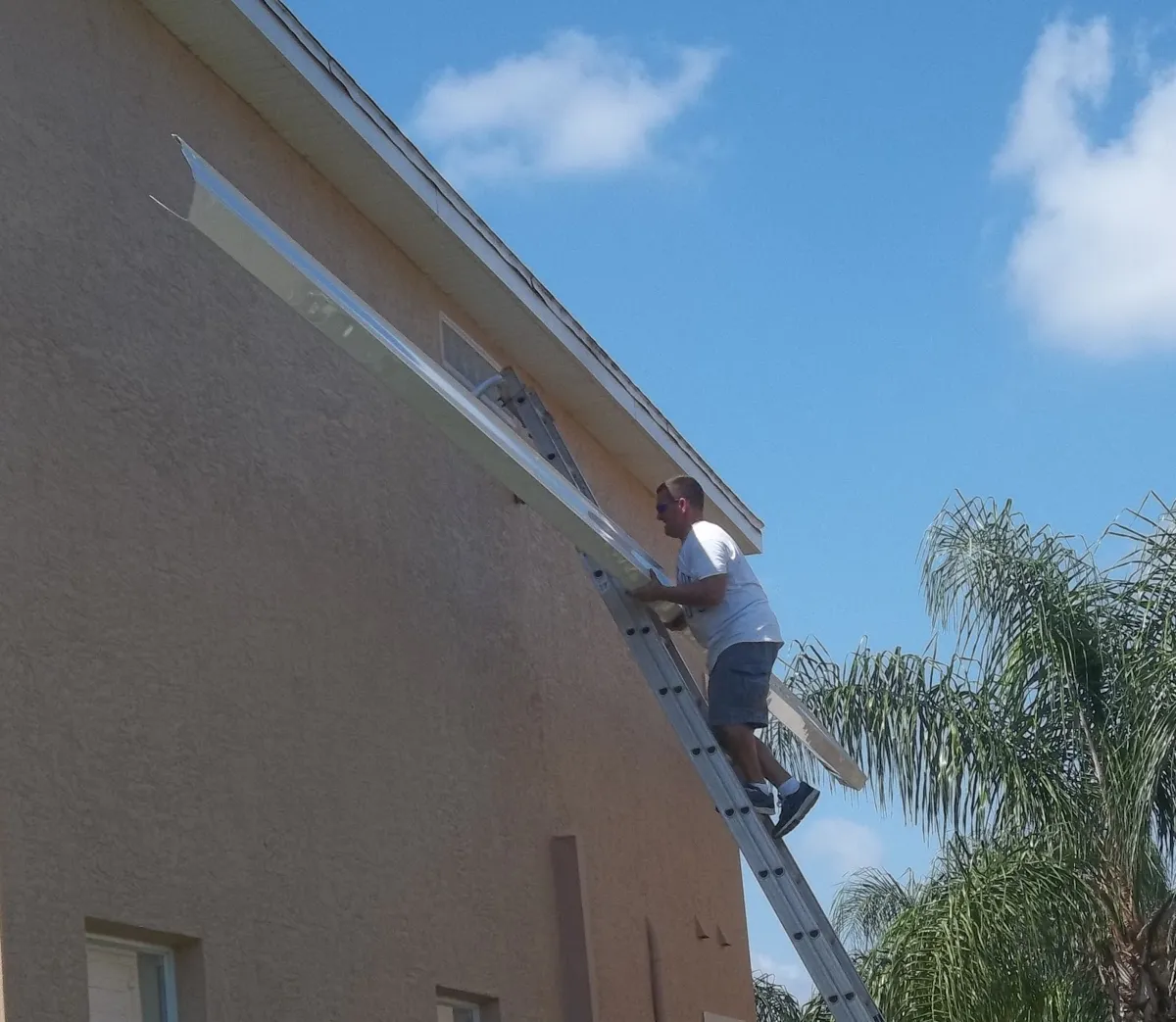
Start at a corner and work along each run. Screw-on guards fasten to the front lip of the gutter with self-tapping screws, kept level and bent to the slope of the roof. Overlap joints the way the instructions say, so water runs over a seam and not into it. Trim neatly at corners and end caps.
5. Do not forget the downspouts
This Old House points out that downspouts can still clog without protection. Make sure the guard covers the outlet and that nothing can drop straight in.
6. Test with a hose
Run a hose on the roof above each run and watch. Water should go through the guard and out the downspout, not over the front edge.
Shingle, tile and metal roofs
Southwest Florida has all three, and each changes the job.
- Shingle: slide-under screens mean lifting the first course of shingles. This Old House warns that working shingles risks damaging them or voiding your roof warranty, and says not to drive fasteners into roof material. A guard that fastens to the gutter lip avoids both.
- Tile: clay and concrete tile can crack under foot and is not meant to be lifted. Choose a guard that fastens to the gutter, and work from the ladder, not the roof.
- Metal: panels are slick and hot in the sun. Again, choose a guard that attaches to the gutter, not the panels.
Check your roof warranty before you start. Many guard companies also require professional installation for their own warranty to apply, and This Old House notes that do-it-yourself guards come with no installation warranty at all.
Ladder safety in the Florida heat
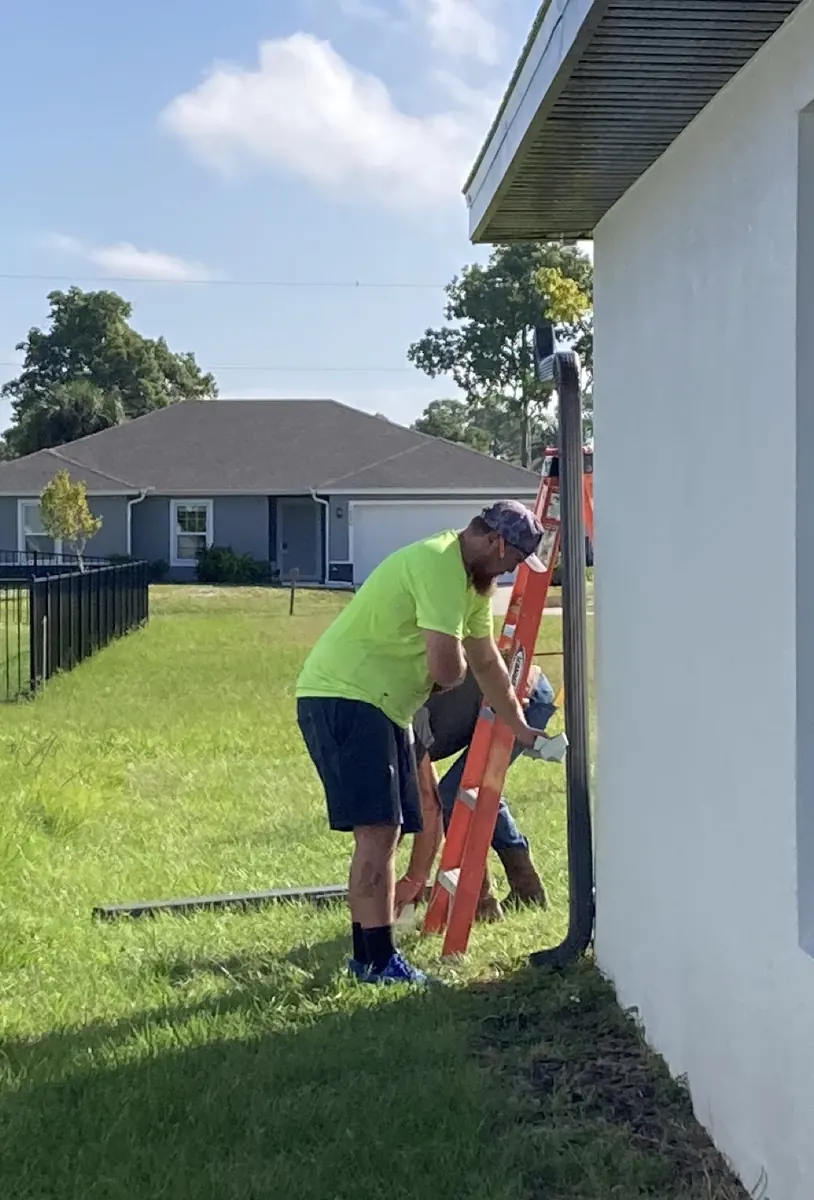
This Old House reports that nearly 247,000 people went to the emergency room in a year with ladder-related injuries, more than for any other piece of DIY equipment. Its basic rules:
- Set an extension ladder at a 4-to-1 angle: 1 foot out from the wall for every 4 feet of height.
- Stay off the top three rungs of an extension ladder.
- Use a fiberglass ladder anywhere near power lines or a service drop.
- Move the ladder instead of leaning out to reach.
Two more for here. The National Weather Service puts Southwest Florida's rainy season at May 15 to October 15, when afternoon storms with lightning build most days, so get off the ladder early. And work in the morning: the sun on a roof edge and an aluminum ladder at 2 p.m. in August is a real hazard on its own.
Common DIY mistakes
- Guards on dirty or failing gutters. This Old House notes that most gutter guards fail because of installation, not the product.
- The wrong guard for the debris. Brush and foam inserts look like a bargain until pine needles and seed pods mat into them.
- Friction fits. Snap-in plastic that is not screwed down is the first thing a summer storm takes off the roof.
- Lifting shingles or tiles. It risks leaks and your roof warranty.
- Skipping the hose test. You find out about water shooting over the edge in the first storm, from your landscaping.
When to call a pro
Hand the job off if the house is two stories, if the gutters need repair first, if the roof is tile or a steep pitch, or if you want micro-mesh fitted tight and covered by a warranty. Compare the cost before you decide: our gutter guards cost guide shows what a professional job runs on a typical house here.
When we install gutter guards, the gutter comes first. We clean the troughs, flush the downspouts and fix leaks, sagging runs and loose hangers before any mesh goes on. Then a fine micro-mesh guard is secured along each run and trimmed at the corners. The estimate is free, there is no deposit, and the workmanship carries our lifetime guarantee.
WWJD Gutters has been family-owned since 2007, and we install guards across Cape Coral, Fort Myers, Naples, Bonita Springs, Punta Gorda and North Fort Myers. If climbing is the part you would rather skip, request a free estimate or call us at (239) 342-5489.
Gutter guards DIY FAQ
Can I install gutter guards myself?
On a single-story house with sound gutters, yes. Clean the gutters, check them for leaks and sags, buy guards sized to your gutter width, and fasten them along each run. This Old House advises leaving anything beyond one story to professionals.
How do you put in gutter guards?
Clean the gutters and flush the downspouts, fix any leaks or loose hangers, measure the runs and the gutter width, then fit the guards from a corner outward, screwing them to the gutter lip. Finish with a hose test.
Which gutter guards are easiest to install yourself?
Brush and foam inserts drop into the trough with no tools. They are also the weakest in Southwest Florida: pine needles get through brush, and foam stays damp and can overflow in heavy rain.
Is it cheaper to install gutter guards yourself?
The materials are. This Old House puts DIY guards at about $1.50 to $6 per linear foot, against an average of about $40 per foot installed. DIY guards come with no installation warranty, so a mistake is yours to fix.
Do DIY gutter guards void my roof warranty?
They can if you lift shingles or fasten into the roof. This Old House warns that working shingles risks damage and your roof warranty. Guards that screw to the gutter lip avoid touching the roof.
Are micro-mesh gutter guards DIY friendly?
Some are sold for DIY, but they are harder to fit because they need precise fitting along the lip and to the roof slope. Many brands require professional installation for their warranty.